Tiller Terrace
Architectural Bas Relief Sculptures
Tiller Terrace is an housing complex in the heart of Portland, Oregon, in the historic Goose Hollow neighborhood.
Around the time Portland was established, this site was home to thriving vegetable gardens farmed by Chinese immigrants, who terraced their fields to take advantage of the flood-prone creek bed nearby.
To recognize the history of the site, I designed a series of eight sculpted plates for the façade.


Studying historical accounts of the neighborhood and era, I illustrated a timeline of agricultural scenes throughout one harvest cycle. An abstraction of the creek flows behind each illustration, unifying the series.
The final 5-foot wide relief panels span the East and West faces of the building, just above ground level. On the East side, day breaks across scenes of tilling, seeding, and tending. Continuing up the hill to the West side of the building – a steep trek the farmers would have made daily – warm afternoon light shines on the harvest and completion of the season.

TILLING

SOWING

WATERING

TENDING

HARVEST

CARRYING THE HARVEST TO MARKET

RESTING
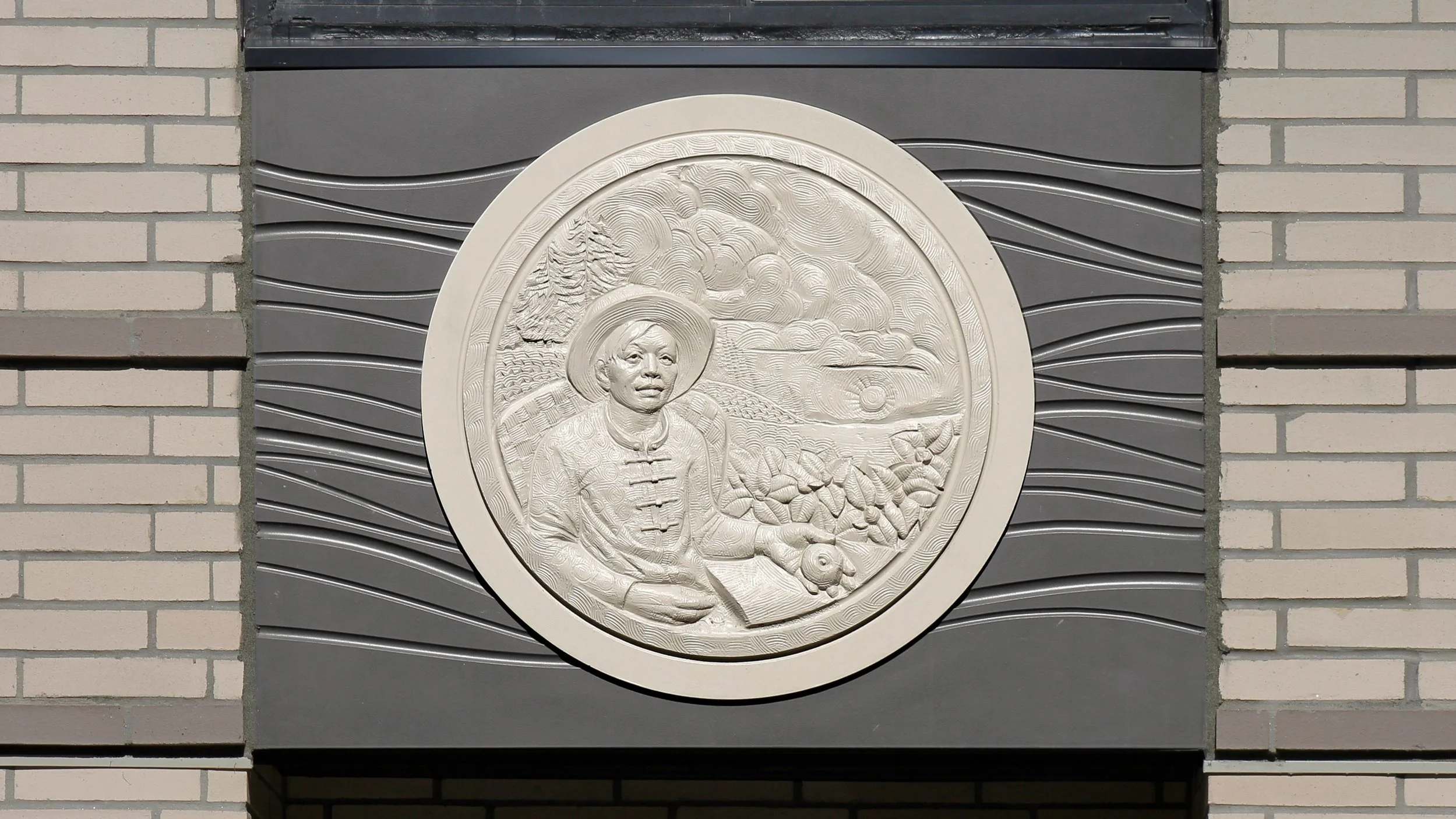
REFLECT & RESET
I worked with the building developer and the architects to refine the concept, placement, material palette, and scale.
To fabricate the plates, I partnered with sculptor Patrick Gracewood and the team at Architectural Castings, a custom masonry studio.
Patrick brought my sketches to life in clay medallions, and the masonry studio created a template to frame them. Each piece was molded and cast in a cement composite, and then finished with weatherproof paint to match the masonry of the building.

Prep
The sculpted clay plates are varnished with shellac to reinforce the surface before a rubber mold is poured.
Mold
A concrete composite is poured into the mold (yellow) to make a final cast (pink).

Frame
Each circular plate is set into a patterned frame cast from the same material. The final piece is approximately 5 feet wide.
The building sits on a bustling downtown block near Providence Park stadium and mass transit.
The farmers who lived and worked here so long ago are a little-known part of the city’s origins, as the farms were lost to rapid development at the turn of the century.
Through this series, their place in Portland’s history is revived and elevated.